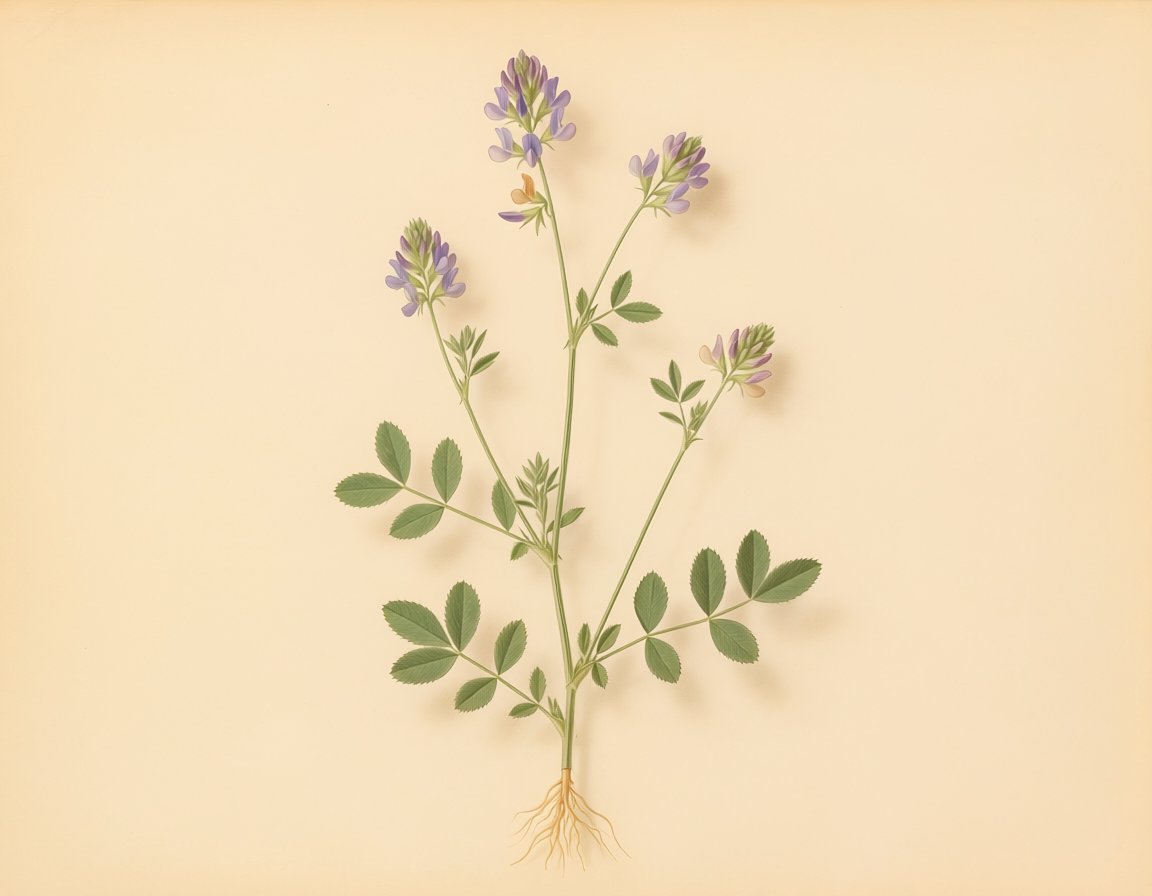
Alfalfa
Medicago sativa
A deep-rooted nitrogen-fixing forage legume. Sprouts and young leaves are eaten as food; dried leaf sometimes appears in green powders, which is a processed form — not a requirement.
GROW → HARVEST → EAT → DRY → POWDER → CAPSULE → GUMMY — forms are not equivalent. Food first.
Identity
Also called: lucerne
What it is
A deep-rooted nitrogen-fixing forage legume. Sprouts and young leaves are eaten as food; dried leaf sometimes appears in green powders, which is a processed form — not a requirement.
From the existing encyclopedia
Alfalfa leaf and sprout are eaten as food in salads and sandwiches, while dried leaf is sometimes blended into green powders. The plant is nitrogen-fixing livestock forage with a mild, grassy flavor. Buy food-grade dried leaf from reputable herb suppliers; keep cool and dry. Culinary amounts in soups or sprinkles on grain bowls differ from high-dose supplement protocols, which are outside aaaLifetime v1 scope.
Edible portions
- sprouts
- young leaves
Absence of a portion from this list means it is not treated as food here — not that every other part is toxic.
Growing
- Climate. 3–9
- Light. Full sun
- Soil. Deep, well-drained, near-neutral; taproot dislikes waterlogging
- Planting. Inoculated seed into a prepared bed; perennial once established.
- Harvest. Cut leafy growth before heavy flowering for drying; sprouts are a kitchen crop, not a field harvest.
Preparation and culinary uses
- Sprouts on sandwiches and salads
- Dried leaf as a mild green sprinkle, not a medicine cup
Nutrition and compounds
- Vitamins (qualitative, well-known associations). vitamin K — not milligram values.
- Minerals (qualitative). calcium, potassium — look up current USDA FoodData Central entries for numbers.
AAA interpretation Food first. These associations explain why a plant shows up in a nutrient conversation — they are not a supplement shopping list.
Safety
- Do not confuse sprouting seed sanitation with supplement claims. People on certain immune-related regimens are often advised to be cautious with raw sprouts — ask a clinician.
Next steps
Sources
- USDA PLANTS Database — taxonomy and range (verify current entries)
- USDA FoodData Central — nutrient profiles for foods (verify current entries; this page does not invent milligrams)
- State cooperative extension growing guides — verify for your region
- Integrated from the existing aaaLifetime / quantum-biohack encyclopedia corpus (unique text preserved where it was not boilerplate).
Honest incompleteness is preferred to fabricated completeness. If a section is missing, no record for it is attached here — not a claim that the plant lacks that characteristic, and not that it was omitted as a secret.
Internal quality class A. Strong page: distinctive plant facts plus practical growing or kitchen use.